What Is It?
Presbyopia is the gradual, age-related loss of the eye’s ability to focus clearly on nearby objects. It is a natural part of aging and commonly becomes noticeable during the early to mid-40s.
To see clearly at different distances, the eye must adjust its focusing power. This process, called accommodation, depends largely on the natural crystalline lens inside the eye. In younger people, the lens is relatively flexible and changes shape to focus on close objects.
As the lens becomes less flexible with age, it can no longer adjust as effectively for near vision. As a result, everyday activities such as reading small print, using a mobile phone, sewing, or working at a computer may become more difficult.
One of the earliest signs is needing to hold a book or phone farther away to make the text clear. Over time, the comfortable reading distance may increase, and additional near-vision correction may be required.
Presbyopia is different from hyperopia (farsightedness), although both can make near objects appear blurry. Presbyopia results from declining accommodation with age, while hyperopia is primarily related to the eye’s optical focusing characteristics.
Presbyopia can occur alongside myopia, hyperopia, astigmatism, or other eye conditions. It generally progresses gradually before stabilizing later in life.
Although the normal aging changes responsible for presbyopia cannot currently be reversed, several effective options are available to improve near vision and daily visual comfort.
Symptoms
Presbyopia typically develops gradually rather than suddenly. Common symptoms include:
• Blurred vision when reading or looking at objects at a normal close-up distance.
• Holding books, newspapers, menus, or mobile phones farther away to see the text clearly.
• Difficulty reading small print, particularly in dim lighting.
• Eye strain, tired eyes, or discomfort after prolonged reading or other near work.
• Headaches following activities that require sustained close focusing.
• Needing brighter light for reading, sewing, or detailed tasks.
• Difficulty switching focus comfortably between near and distant objects.
Symptoms may initially be more noticeable when a person is tired or working in poor lighting conditions.
The degree of difficulty depends on age, existing spectacle prescription, working distance, lighting conditions, and individual visual needs.
Sudden vision loss, new flashes of light, a curtain over the vision, severe eye pain, or abrupt changes in sight are not typical features of uncomplicated presbyopia and require urgent medical assessment.
Causes
The primary cause of presbyopia is the gradual age-related reduction in the eye’s ability to accommodate, or adjust focus for nearby objects.
Inside the eye, the transparent crystalline lens helps focus incoming light onto the retina. During near vision, the ciliary muscle and associated structures allow the lens to change shape, increasing its focusing power.
With advancing age, the natural lens becomes progressively less flexible. Its ability to change shape decreases, reducing the amount of focusing power available for near tasks.
As this process continues, objects at a normal reading distance may no longer be brought into sharp focus without additional optical correction.
Presbyopia is not caused by reading too much, using digital screens, or wearing eyeglasses. These activities may make the symptoms more noticeable, but they do not cause the underlying age-related changes.
Unlike some other causes of blurred vision, presbyopia is an expected physiological change rather than damage to the retina or optic nerve.
Risk Factors
The main risk factor for presbyopia is increasing age. Because it is part of the normal aging process, nearly everyone experiences some decline in near-focusing ability over time.
Factors that may influence when symptoms are noticed or how troublesome they become include:
• Age over 40: Near-focusing difficulties commonly begin to become noticeable during the early to mid-40s.
• Existing hyperopia: People who are farsighted may notice near-vision difficulties earlier or more prominently.
• Existing refractive errors: Myopia, astigmatism, and other focusing errors can affect the type of correction required.
• Visually demanding near work: Frequent reading, detailed professional work, or extended use of digital devices may make symptoms more apparent.
• Poor lighting: Dim illumination can increase difficulty with small print and close-up tasks.
In some cases, unusually early loss of near-focusing ability may be associated with medical conditions or medications. Symptoms appearing significantly earlier than expected should be evaluated by an eye care professional.
Presbyopia itself is not contagious and is not caused by infection or inflammation.
Diagnosis
Presbyopia is diagnosed during a comprehensive eye examination. The ophthalmologist evaluates near and distance vision, focusing ability, and any additional refractive or eye-health problems that may be contributing to the symptoms.
The assessment may include:
Medical and Visual History
The ophthalmologist asks about reading difficulties, screen use, occupation, current glasses or contact lenses, and when symptoms first appeared.
Distance Visual Acuity Testing
Distance vision is measured to identify any additional refractive errors that may require correction.
Near Visual Acuity Testing
The patient reads text or symbols at a standard near distance to assess close-up visual clarity.
Refraction Assessment
The appropriate optical prescription is determined, including any additional near-focusing power needed for comfortable reading.
Accommodation and Near-Vision Assessment
The examination may evaluate focusing performance and the patient’s preferred working distance.
Eye Health Examination
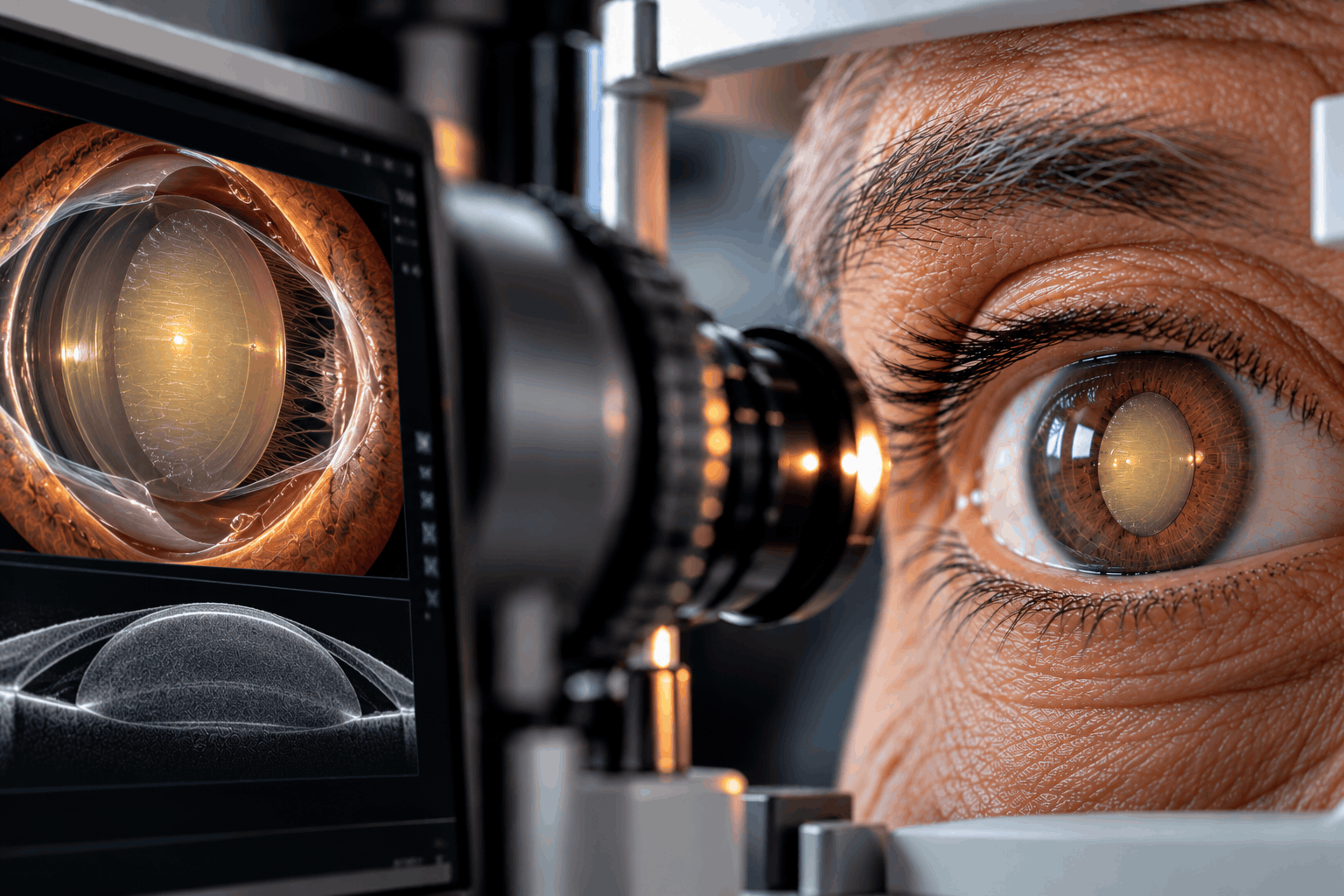
A slit-lamp examination and other appropriate investigations help assess the cornea, lens, and overall eye health. Additional examination may be recommended to exclude cataracts, retinal disorders, or other causes of blurred vision.
The final prescription is tailored to the patient’s daily activities, visual requirements, and existing distance correction.
Treatment Options
Presbyopia can be managed effectively using optical correction and, in selected patients, medical or surgical approaches. The most appropriate option depends on the patient’s age, eye health, existing refractive error, lifestyle, and visual expectations.
1. Reading Glasses
Reading glasses provide additional focusing power for close-up activities. They may be sufficient for people who otherwise have good distance vision. Over-the-counter readers can be helpful, but a professional examination is important to identify the most suitable correction.
2. Bifocal and Progressive Glasses
Patients who need both distance and near correction may benefit from multifocal spectacles. Bifocal lenses provide separate optical zones, while progressive lenses allow a gradual transition between different viewing distances.
3. Occupational or Computer Glasses
Specially prescribed lenses can be useful for people who spend long periods working at computer or intermediate distances. These can be tailored to specific professional and daily visual needs.
4. Multifocal Contact Lenses
Multifocal contact lenses provide optical correction for more than one viewing distance. Suitability depends on the patient’s prescription, tear-film condition, and ability to tolerate contact lenses.
5. Monovision Contact Lenses
Monovision corrects one eye primarily for distance and the other for near or intermediate vision. Some patients adapt well, while others experience reduced depth perception or difficulty with certain activities. A contact lens trial may help determine suitability.
6. Prescription Eye Drops
Certain prescription eye drops can temporarily improve near vision in selected adults by changing pupil size and increasing depth of focus. Their effects are temporary, they may have side effects, and they are not suitable for every patient. Availability and regulatory approval vary by country.
7. Laser Vision Correction
Selected patients may be considered for laser procedures that create a monovision effect. These procedures require careful evaluation of corneal health, refractive stability, and the patient’s ability to adapt to monovision.
8. Lens-Based Surgical Options
For appropriately selected patients, lens-based procedures, including refractive lens exchange or certain intraocular lens implants during cataract surgery, may reduce dependence on reading glasses. These are surgical options with benefits, limitations, and potential risks that must be discussed individually.
No single treatment is ideal for everyone, and some patients may still need glasses for certain activities even after medical or surgical treatment.
A comprehensive ophthalmic examination is essential before selecting any treatment beyond routine optical correction.
Prevention & Care
Presbyopia is a natural part of aging, and there is currently no proven method to prevent the underlying loss of accommodation.
However, practical measures can reduce visual discomfort and support comfortable near vision:
• Schedule regular comprehensive eye examinations, particularly after age 40.
• Use accurately prescribed reading glasses or multifocal lenses when needed.
• Ensure adequate, comfortable lighting when reading or performing detailed tasks.
• Increase text size on smartphones, tablets, and computer screens.
• Maintain a comfortable reading and working distance.
• Take regular breaks during prolonged screen use or other visually demanding tasks.
• Address dry-eye symptoms or other ocular conditions that may worsen visual discomfort.
• Discuss changing visual needs with an ophthalmologist, especially if current glasses are no longer effective.
• Maintain general eye health through appropriate management of existing medical and ocular conditions.
Reading glasses and other appropriate optical corrections do not make presbyopia progress faster.
Because changes in vision can also result from cataracts, glaucoma, retinal disease, or other conditions, persistent or unusual visual symptoms should not automatically be attributed to aging.
Seek urgent ophthalmic assessment for sudden vision loss, new flashes or floaters accompanied by visual disturbance, severe eye pain, or other rapid changes in vision.
Frequently Asked Questions
What is presbyopia?
At what age does presbyopia usually begin?
Is presbyopia the same as farsightedness?
Can presbyopia be prevented?
Does presbyopia affect distance vision?
Will wearing reading glasses make presbyopia worse?
Can I have presbyopia and myopia at the same time?
Can contact lenses correct presbyopia?
Is surgery necessary for presbyopia?
Can eye drops treat presbyopia?
Does presbyopia eventually stop progressing?
When should I see an ophthalmologist?
Our team can help you with an individual medical assessment.