
What Is It?
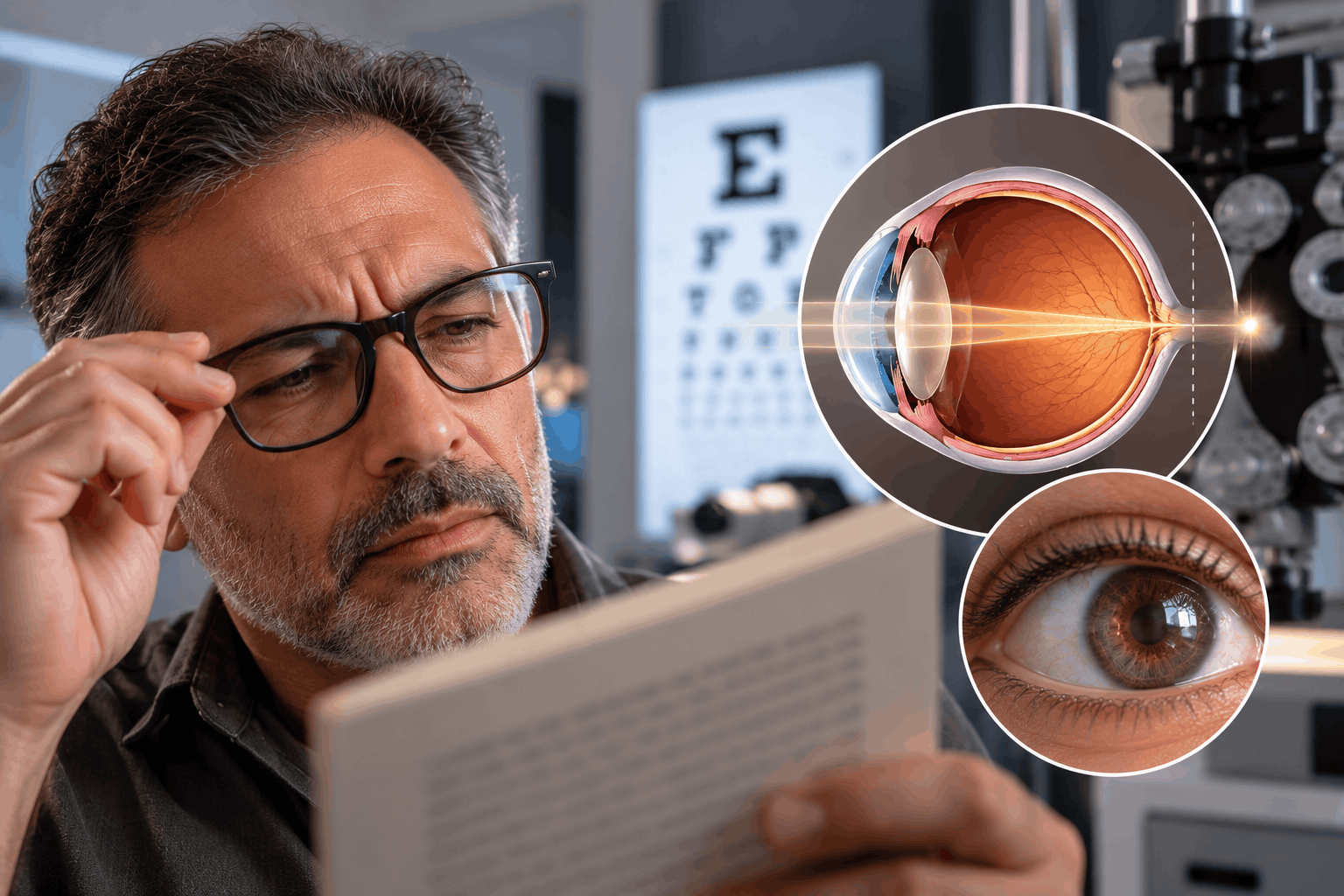
Hyperopia, commonly known as farsightedness or long-sightedness, is a refractive error that occurs when the eye does not focus incoming light accurately on the retina.
The retina is the light-sensitive tissue at the back of the eye that converts visual information into signals interpreted by the brain. For clear vision, light rays must be focused precisely on the retinal surface.
In an eye with hyperopia, the optical system is relatively underpowered for the eye's length. Without sufficient accommodation, incoming light would be focused behind the retina rather than directly on it.
This usually occurs because the eyeball is shorter than average from front to back or because the cornea or lens has insufficient focusing power.
As a result, close-up activities such as reading, writing, sewing, or using a smartphone may require additional focusing effort.
Young people with mild hyperopia may be able to compensate by using accommodation, the natural ability of the eye's lens to change its focusing power. Consequently, some patients can see clearly without realizing they have hyperopia.
As focusing demands increase, or accommodation becomes less effective with age, symptoms may become more noticeable.
In moderate or high hyperopia, both near and distance vision may be blurred.
Hyperopia can affect one eye or both eyes and may coexist with astigmatism or presbyopia.
Hyperopia in Children
A small amount of hyperopia is common in infants and young children and may decrease naturally as the eye grows.
However, significant hyperopia can increase the risk of accommodative esotropia, in which one or both eyes turn inward, and amblyopia, a developmental reduction in vision.
Early assessment is important because children may not recognize or report their visual difficulties.
Hyperopia vs. Presbyopia
Although both conditions can cause difficulty with near vision, they are not the same.
Hyperopia is primarily associated with the eye's optical structure and refractive power. Presbyopia is the age-related reduction in the eye's ability to accommodate.
Both conditions can occur in the same person, particularly after the age of 40.
With an accurate diagnosis and appropriate optical correction, most people with hyperopia can achieve clear and comfortable vision.
Symptoms
Symptoms of hyperopia depend on the degree of refractive error, age, focusing ability, and visual demands.
Some people with mild hyperopia have no noticeable symptoms, especially during childhood and early adulthood.
Common symptoms include:
• Blurred vision when looking at nearby objects.
• Difficulty reading books, newspapers, or small text.
• Eye strain during prolonged reading or computer work.
• Headaches after close-up activities.
• Tired, aching, or uncomfortable eyes.
• Difficulty maintaining clear focus during near tasks.
• Squinting to see objects more clearly.
• Blurred distance vision in moderate or high hyperopia.
• Reduced visual comfort after prolonged focusing.
• Needing frequent breaks while reading or studying.
Symptoms in Children
Children with hyperopia may experience eyestrain or difficulty with close work, although they may not complain of blurred vision.
Possible signs include:
• Avoiding reading or other visually demanding tasks.
• Complaints of headaches or tired eyes.
• Difficulty maintaining attention during close-up activities.
• Eye rubbing or squinting.
• One eye turning inward, particularly during focusing.
• Reduced vision in one or both eyes if amblyopia develops.
These signs are not specific to hyperopia and require an eye examination for accurate diagnosis.
Symptoms in Adults
Adults may notice increased difficulty reading, particularly as their natural focusing ability declines with age.
Hyperopia can become more symptomatic when presbyopia develops, making appropriate near-vision correction increasingly important.
Sudden visual loss, significant eye pain, or abrupt changes in vision are not typical symptoms of uncomplicated hyperopia and require prompt medical assessment.
Causes
Hyperopia occurs when the refractive power of the eye is insufficient relative to its length, causing light to focus behind the retinal plane unless the eye compensates by accommodating.
The main causes include:
1. Shorter-Than-Average Eyeball
The most common structural cause is an eyeball that is relatively short from front to back.
Because the distance between the eye's focusing structures and the retina is reduced, the optical system would focus incoming light behind the retina.
2. Relatively Flat Corneal Curvature
The cornea contributes a large proportion of the eye's focusing power.
If the cornea is flatter than usual, it may bend incoming light less effectively, contributing to hyperopia.
3. Insufficient Lens or Overall Optical Power
Differences in the focusing power or position of the eye's optical structures may also contribute.
4. Genetic and Developmental Factors
Hyperopia often has a familial component.
Many children are naturally born with some hyperopia because their eyes are still developing.
As the eyeball grows, the degree of hyperopia may decrease through a normal developmental process called emmetropization.
5. Changes Following Certain Eye Conditions or Procedures
Changes in the eye's optical system can occasionally cause a hyperopic shift in refraction.
Examples may include selected postoperative refractive changes or alterations in lens status.
Hyperopia is not caused by reading too much, sitting close to a television, or using digital screens.
These activities may make existing focusing difficulties more noticeable because they increase the demand for near vision.
Unlike presbyopia, which is primarily related to age-associated loss of accommodation, hyperopia reflects the eye's underlying refractive characteristics.
Risk Factors
Hyperopia can affect people of all ages, including infants, children, and adults.
Factors associated with hyperopia include:
Family History
People with parents or close relatives who have significant hyperopia may have an increased likelihood of developing the condition.
Childhood Eye Development
A degree of hyperopia is common during early childhood because the eyes are still growing.
Shorter Axial Eye Length
Individuals with relatively short eyes may have greater degrees of hyperopia.
Differences in Corneal or Lens Power
A relatively flat cornea or other optical characteristics that reduce focusing power can contribute to farsightedness.
Certain Congenital or Developmental Eye Conditions
Some conditions affecting eye growth and structure may be associated with high hyperopia.
Age-Related Reduction in Accommodation
Aging does not necessarily cause the structural refractive error, but reduced accommodation can make previously compensated hyperopia more noticeable.
Presence of Significant Hyperopia in Childhood
Children with higher degrees of hyperopia have an increased risk of developing accommodative esotropia and amblyopia.
Hyperopia itself is not an infection and cannot spread from one person to another.
Risk factors do not determine the severity of symptoms in every patient. Some individuals have significant hyperopia but remain relatively comfortable, while others experience substantial eyestrain with smaller refractive errors.
Diagnosis
Hyperopia is diagnosed during a comprehensive eye examination that assesses visual acuity, refractive error, accommodation, eye alignment, and general ocular health.
1. Medical and Visual History
The ophthalmologist asks about blurred vision, headaches, eyestrain, difficulty reading, school or work activities, and previous use of glasses or contact lenses.
In children, parents may be asked about eye turning, reading behavior, family history, and previous vision screening results.
2. Distance Visual Acuity Testing
The patient reads letters or symbols on a vision chart to measure clarity at distance.
People with mild hyperopia may have normal distance visual acuity because they can compensate using accommodation.
3. Near Vision Assessment
The ophthalmologist evaluates the patient's ability to read and focus on nearby text or objects.
4. Refraction Testing
A refraction determines the prescription needed to focus light accurately on the retina.
Hyperopia is generally corrected with positive or plus-powered lenses, recorded using a plus (+) diopter value.
5. Autorefraction and Retinoscopy
These techniques provide objective measurements of the eye's refractive error.
Retinoscopy is particularly useful in young children and patients who cannot reliably complete a subjective refraction.
6. Cycloplegic Refraction
Cycloplegic eye drops temporarily relax accommodation, allowing a more accurate measurement of the full hyperopic refractive error.
This is particularly important in children and in patients with suspected accommodative esotropia or hidden hyperopia.
7. Eye Alignment Assessment
Cover testing and other binocular vision tests may be performed, especially in children, to identify strabismus or focusing-related eye deviations.
8. Amblyopia Assessment
The ophthalmologist evaluates whether vision in either eye is reduced beyond what would be expected from refractive error alone.
9. Eye Health Examination
A slit-lamp examination and, when appropriate, a dilated retinal examination are used to assess overall eye health and exclude other causes of visual difficulties.
10. Additional Measurements
Corneal measurements, axial length assessment, or other investigations may be performed when clinically indicated or when refractive surgery is being considered.
The final prescription is individualized according to age, symptoms, refractive measurements, eye alignment, and visual requirements.
Treatment Options
Treatment of hyperopia aims to improve visual clarity, reduce focusing strain, and prevent complications associated with significant uncorrected farsightedness.
The best treatment depends on the degree of hyperopia, the patient's age, symptoms, visual demands, and associated eye conditions.
1. Prescription Eyeglasses
Eyeglasses are the most common and straightforward method of correcting hyperopia.
Plus-powered convex lenses increase the eye's effective focusing power, helping light focus correctly on the retina.
Glasses may be prescribed for full-time wear or for particular visual tasks, depending on the patient's examination findings.
In children with accommodative esotropia or a risk of amblyopia, consistent use of appropriate glasses may be especially important.
2. Contact Lenses
Contact lenses can provide effective correction for many patients with hyperopia.
They may be suitable for individuals who prefer an alternative to glasses for sports, work, or daily activities.
Proper fitting, cleaning, and safe handling are essential to reduce the risk of eye infections.
3. Monitoring Mild Hyperopia in Children
Some children with low levels of hyperopia, normal eye alignment, good visual development, and no significant symptoms may not require immediate glasses.
Regular follow-up allows the ophthalmologist to monitor refractive development, visual acuity, and binocular vision.
Moderate or high hyperopia, eye crossing, or amblyopia may require more active management.
4. Treatment of Accommodative Esotropia
Children whose eyes turn inward because of excessive focusing effort may benefit significantly from appropriate hyperopic glasses.
Some children achieve normal eye alignment while wearing their prescription, while others may require additional treatment.
5. Amblyopia Treatment
If significant hyperopia contributes to amblyopia, treatment may involve prescription glasses together with eye patching, atropine penalization, or other specialist-directed approaches when necessary.
Early treatment helps maximize the potential for normal visual development.
6. Laser Refractive Surgery
Selected adults with stable prescriptions may be considered for laser vision correction.
Procedures such as LASIK or PRK reshape the cornea to improve the focusing of light.
Suitability depends on several factors, including:
• Degree of hyperopia.
• Stability of the refractive prescription.
• Corneal thickness and shape.
• Tear-film condition.
• Overall eye health.
• Expected visual outcomes.
Laser surgery is not suitable for every patient, and the effective treatment range for hyperopia may be more limited than for myopia.
7. Lens-Based Refractive Surgery
For selected adults, particularly those with higher refractive errors or age-related lens changes, lens-based procedures may be considered.
Refractive lens exchange involves replacing the natural crystalline lens with an intraocular lens designed to provide appropriate optical correction.
This is an intraocular operation and carries risks that must be considered carefully.
8. Presbyopia Management
Adults who have both hyperopia and presbyopia may require multifocal, bifocal, progressive, or other specialized lenses for comfortable vision at different distances.
9. Follow-Up and Prescription Adjustments
Regular eye examinations help determine whether the prescription remains appropriate.
Children may experience changes as the eye grows, while adults may notice increased focusing difficulty as accommodation declines.
10. Treatment Limitations and Safety
Neither reading exercises nor vitamins have been shown to reverse the structural causes of hyperopia.
Refractive surgery does not guarantee freedom from glasses and is not an appropriate choice for all patients.
Treatment should be selected after discussing the benefits, limitations, potential risks, and the patient's individual visual needs with an ophthalmologist.
Prevention & Care
Hyperopia is usually related to the natural structure and optical characteristics of the eye. There is currently no proven method to prevent inherited or developmental farsightedness.
However, early diagnosis and appropriate vision correction can help maintain visual comfort and reduce the risk of complications.
Recommended measures include:
• Arrange regular comprehensive eye examinations.
• Ensure children receive age-appropriate vision screening.
• Seek an eye examination if a child develops eye crossing, frequent squinting, or unexplained difficulty with near activities.
• Wear prescribed eyeglasses or contact lenses according to the ophthalmologist's recommendations.
• Attend scheduled follow-up visits when significant hyperopia is diagnosed during childhood.
• Follow treatment plans for associated amblyopia or accommodative esotropia.
• Use adequate lighting for reading and detailed tasks.
• Take regular breaks during prolonged near work to reduce visual discomfort.
• Adjust screen distance, text size, and working conditions to improve comfort.
• Follow appropriate contact lens hygiene practices.
• Report persistent headaches, eyestrain, or blurred vision despite using prescribed correction.
• Discuss new visual symptoms or changing prescription requirements with an eye care professional.
For Children
Early detection is especially important because significant uncorrected hyperopia can interfere with normal visual development.
Some children with farsightedness require glasses even if they do not complain about their vision.
For Adults
Aging can reduce the ability to compensate for hyperopia, making near-vision symptoms more apparent.
An updated prescription or additional near correction may improve reading comfort.
Wearing correctly prescribed glasses does not make hyperopia worse or weaken the eyes.
Urgent medical attention is recommended for sudden vision loss, severe eye pain, or other abrupt visual changes, as these are not typical signs of uncomplicated hyperopia.
Frequently Asked Questions
What is hyperopia?
Is hyperopia the same as farsightedness?
What are the main symptoms of hyperopia?
Can people with hyperopia see distant objects clearly?
What causes hyperopia?
Is hyperopia hereditary?
Can children have hyperopia?
Can children outgrow hyperopia?
Can hyperopia cause crossed eyes?
Can hyperopia cause lazy eye?
What is the difference between hyperopia and presbyopia?
How is hyperopia diagnosed?
What type of glasses correct hyperopia?
Can contact lenses correct hyperopia?
Can LASIK treat hyperopia?
Does everyone with hyperopia need surgery?
Can eye exercises cure hyperopia?
Will wearing glasses make hyperopia worse?
Can hyperopia worsen with age?
When should I see an ophthalmologist?
Our team can help you with an individual medical assessment.