
What Is It?
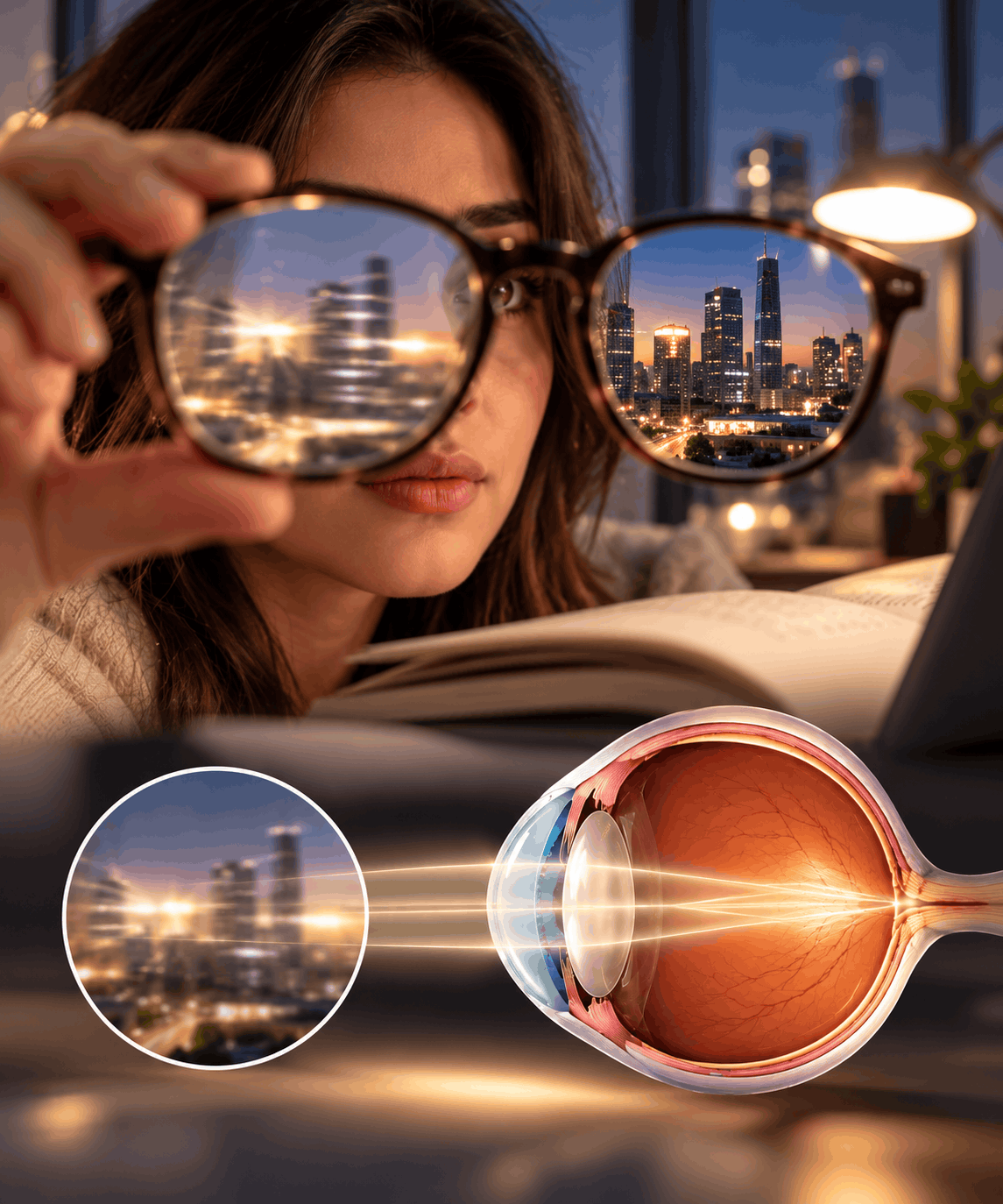
Astigmatism is a common refractive error that occurs when the cornea or the natural lens inside the eye has different curvatures in different directions.
The cornea is the transparent front surface of the eye. Together with the natural lens, it focuses incoming light onto the retina, allowing the brain to form clear images.
In an eye without astigmatism, light is focused more evenly. When astigmatism is present, light does not focus at a single sharp point on the retina, causing blurred or distorted vision.
Astigmatism can affect vision at both near and far distances. It frequently occurs alongside nearsightedness (myopia) or farsightedness (hyperopia).
There are two important forms:
1. Regular Astigmatism
The main curvatures of the cornea or lens are relatively uniform along different meridians.
This is the most common form and can usually be corrected with prescription eyeglasses or toric contact lenses.
2. Irregular Astigmatism
The corneal surface has uneven or less predictable curvature that may not be fully corrected with ordinary glasses.
Irregular astigmatism may occur with keratoconus, corneal scarring, or after certain eye injuries or surgeries.
Astigmatism may be present from birth or develop as the eye changes during childhood or adulthood. It can affect one or both eyes.
Mild astigmatism may cause few or no symptoms. More significant astigmatism can interfere with reading, driving, screen use, and other activities requiring clear vision.
Astigmatism is generally manageable. Most patients achieve good visual correction with eyeglasses or contact lenses, while appropriately selected adults may be candidates for refractive surgery.
In children, significant uncorrected astigmatism may interfere with visual development and contribute to amblyopia (lazy eye). Early vision screening is therefore particularly important.
Symptoms
Astigmatism symptoms depend on its severity, the presence of other refractive errors, and individual visual needs.
Common symptoms include:
• Blurred vision at near or far distances.
• Distorted, stretched, or unclear images.
• Difficulty seeing fine details.
• Eye strain, particularly after reading or prolonged screen use.
• Headaches associated with visual effort.
• Frequent squinting to see more clearly.
• Difficulty seeing clearly at night.
• Glare, halos, or streaking around lights in some patients.
• Difficulty achieving comfortable vision with an outdated glasses prescription.
Mild astigmatism may cause no noticeable symptoms.
Symptoms can affect one or both eyes and may be more apparent during tasks that require sustained concentration.
Signs in Children
Children may not realize that their vision is blurred or distorted.
Possible signs include:
• Squinting or tilting the head.
• Difficulty seeing the classroom board.
• Holding books or screens unusually close.
• Complaints of headaches or tired eyes.
• Difficulty with certain reading or visual activities.
These signs are not specific to astigmatism and require proper visual assessment.
Important Warning Signs
Sudden vision loss, significant eye pain, marked redness, or a rapid unexplained change in vision is not typical of uncomplicated astigmatism and requires urgent medical evaluation.
Frequent or rapidly changing astigmatism, particularly in younger patients, should also prompt evaluation for underlying corneal disorders such as keratoconus.
Causes
Astigmatism occurs when the cornea or natural lens has different curvatures in different directions, preventing light from focusing evenly onto the retina.
The exact reason why many people develop astigmatism is not fully understood.
Several mechanisms may contribute:
1. Natural Corneal Shape
The most common form is related to differences in the curvature of the cornea.
Instead of having the same curvature in all directions, the cornea is steeper along one meridian than another.
This creates different focusing powers and causes blurred or distorted images.
2. Lenticular Astigmatism
Astigmatism can also result from differences in the shape or optical properties of the natural lens inside the eye.
Lens changes associated with aging may alter the amount or direction of astigmatism.
3. Inherited and Developmental Factors
Astigmatism often begins in childhood and can run in families.
The shape and optical characteristics of the eye may change during growth.
4. Corneal Disorders
Conditions such as keratoconus can cause progressive corneal thinning and irregular curvature.
These conditions may produce irregular astigmatism that is difficult to correct with ordinary eyeglasses.
5. Eye Injury or Corneal Scarring
Corneal injuries, infections, or scars may change the normal curvature of the cornea and create irregular astigmatism.
6. Previous Eye Surgery
Certain eye surgeries may alter corneal shape and influence astigmatism.
Astigmatism is not caused by reading in dim light, sitting too close to a television, or using digital screens.
Although prolonged visual tasks may cause eye strain, they do not directly create the structural refractive error responsible for ordinary astigmatism.
Risk Factors
Astigmatism is common and can occur in otherwise healthy eyes.
Factors associated with astigmatism or particular forms of astigmatism include:
• A family history of astigmatism or other refractive errors.
• Natural differences in corneal shape present from birth or developing during childhood.
• Corneal disorders such as keratoconus.
• Previous corneal injury or scarring.
• Certain eye surgeries.
• Changes in the natural lens with age.
• Certain inherited or developmental eye conditions.
Irregular or progressively increasing astigmatism may be associated with an underlying corneal condition rather than ordinary refractive development.
Having a risk factor does not necessarily mean significant astigmatism will occur.
Children may have astigmatism without obvious symptoms, making age-appropriate vision screening essential.
Adults with changing prescriptions should attend comprehensive eye examinations to determine whether the change is due to ordinary refractive variation or another eye condition.
Diagnosis
Astigmatism is diagnosed through a comprehensive eye examination that measures visual acuity, refractive error, and, when indicated, corneal shape.
The ophthalmologist may perform the following investigations:
1. Visual Acuity Testing
The patient reads letters or symbols on a standardized eye chart to determine how clearly each eye sees at different distances.
This helps assess the effect of astigmatism on visual function.
2. Refraction Test
Using a phoropter or trial lenses, the examiner determines the prescription that provides the clearest possible vision.
The prescription may include spherical power, cylindrical power, and axis.
Cylinder describes the amount of astigmatic correction, while axis describes its orientation.
3. Autorefraction
An autorefractor provides an objective estimate of the eye's focusing characteristics.
The results help guide further refraction testing but do not always replace a complete clinical assessment.
4. Keratometry
Keratometry measures the curvature of the central cornea.
It helps quantify corneal astigmatism and may assist with contact lens fitting or surgical planning.
5. Corneal Topography
Corneal topography maps the curvature of the corneal surface.
It may be recommended when astigmatism is unusually high, irregular, progressive, or when refractive surgery is being considered.
6. Corneal Tomography
Corneal tomography provides additional information about the front and back corneal surfaces and corneal thickness distribution.
It is especially useful when keratoconus or another corneal ectatic disorder is suspected.
7. Slit-Lamp Examination
The ophthalmologist examines the cornea, lens, and other anterior eye structures to identify conditions that may contribute to reduced or distorted vision.
8. Cycloplegic Refraction in Children
In selected children, special eye drops temporarily relax the eye's focusing mechanism to allow a more accurate assessment of refractive error.
This is particularly useful when prescribing glasses for younger patients or evaluating amblyopia risk.
Not every patient requires all these tests.
The ophthalmologist selects investigations according to the patient's age, symptoms, degree of astigmatism, and whether an underlying corneal abnormality is suspected.
Treatment Options
Treatment of astigmatism aims to provide clear, comfortable vision and address any underlying eye condition when present.
The most appropriate treatment depends on the degree and type of astigmatism, age, visual requirements, corneal health, and patient preferences.
1. Prescription Eyeglasses
Eyeglasses are one of the simplest and safest ways to correct regular astigmatism.
Specially prescribed cylindrical lenses compensate for differences in the eye's focusing power.
Glasses can improve clarity at near and far distances and reduce symptoms of visual strain.
An accurate prescription is important, particularly when astigmatism is combined with nearsightedness or farsightedness.
2. Toric Contact Lenses
Toric contact lenses are designed to correct regular astigmatism.
They are available in different designs and materials.
Proper professional fitting is necessary to ensure suitable vision, comfort, and eye health.
Patients must follow contact lens hygiene instructions to reduce the risk of infection.
3. Rigid Gas-Permeable and Specialized Contact Lenses
Rigid gas-permeable lenses may provide improved optical correction in selected patients.
For irregular astigmatism associated with corneal conditions such as keratoconus, specialized contact lenses, including scleral lenses, may provide better vision than ordinary glasses.
These lenses require specialist assessment and fitting.
4. Laser Vision Correction
Refractive procedures such as LASIK or PRK can correct astigmatism in appropriately selected adults by reshaping the cornea.
Eligibility depends on several factors, including:
• A stable refractive prescription.
• Adequate corneal thickness and suitable corneal shape.
• Healthy ocular surface.
• Absence of contraindicating corneal disease.
• Realistic expectations regarding visual outcomes.
Laser vision correction is not suitable for everyone.
Potential complications include dry eye symptoms, glare, halos, and other visual disturbances. Rare but serious complications may occur.
Keratoconus and other corneal ectatic disorders are important reasons to avoid standard laser refractive surgery.
5. Astigmatism Correction During Cataract Surgery
When cataract surgery is indicated, astigmatism may also be addressed in selected patients.
Possible options include toric intraocular lenses or other surgical approaches according to corneal measurements and individual needs.
These procedures are considered as part of cataract management rather than routine treatment for everyone with astigmatism.
6. Management of Underlying Corneal Disease
When astigmatism is caused by keratoconus, corneal scarring, or another disorder, treatment focuses on both the visual error and the underlying condition.
For example, corneal cross-linking may be recommended for progressive keratoconus to help stabilize the cornea.
Cross-linking is not a routine treatment for ordinary regular astigmatism.
7. Observation and Follow-Up
Mild astigmatism that causes no significant visual difficulty may not require immediate correction.
Regular eye examinations help identify prescription changes and associated eye conditions.
Children with clinically significant astigmatism require timely correction and monitoring because uncorrected refractive errors can affect visual development.
The ophthalmologist will recommend the most appropriate management based on the examination findings and the patient's visual needs.
Prevention & Care
There is no proven way to prevent ordinary astigmatism, because it is usually related to the natural shape of the cornea or lens.
However, regular eye care can help identify changes early and ensure appropriate vision correction.
Recommended measures include:
• Attend regular comprehensive eye examinations.
• Ensure children receive age-appropriate vision screening.
• Wear prescribed glasses or contact lenses as recommended.
• Follow appropriate contact lens hygiene and replacement schedules.
• Avoid rubbing the eyes excessively, particularly if a corneal disorder is suspected.
• Use protective eyewear during activities that may cause eye injury.
• Seek examination when vision becomes progressively blurred or distorted.
• Discuss frequent prescription changes with an ophthalmologist.
• Obtain specialist corneal assessment when irregular or progressive astigmatism is suspected.
Astigmatism and Digital Screens
Prolonged screen use may cause eye strain, especially when astigmatism is uncorrected.
Taking regular breaks, blinking normally, and using an accurate prescription may improve comfort.
Screen use does not directly cause ordinary astigmatism.
Astigmatism in Children
Significant uncorrected astigmatism during visual development may contribute to amblyopia.
Children should receive timely screening and prescribed correction when indicated.
When Should You See an Eye Doctor?
Arrange an eye examination if you experience:
• Persistent blurred or distorted vision.
• Frequent headaches associated with visual tasks.
• Difficulty seeing clearly at night.
• Repeated changes in glasses prescriptions.
• Vision that remains unclear despite appropriate glasses.
• Signs of visual difficulty in a child.
Rapidly increasing or irregular astigmatism should be evaluated for possible corneal disease.
Seek urgent medical attention for sudden vision loss, severe eye pain, or significant redness with impaired vision.
With proper diagnosis and appropriate correction, most patients with ordinary astigmatism can achieve clear and comfortable vision.
Frequently Asked Questions
What is astigmatism?
Is astigmatism an eye disease?
What causes astigmatism?
Can astigmatism affect both near and distance vision?
Is astigmatism hereditary?
Can children have astigmatism?
Can astigmatism cause lazy eye?
Does astigmatism get worse with age?
Can glasses correct astigmatism?
Can contact lenses correct astigmatism?
Can LASIK correct astigmatism?
Is laser eye surgery suitable for everyone with astigmatism?
Is astigmatism the same as keratoconus?
Can astigmatism cause headaches?
Does using a computer cause astigmatism?
Can astigmatism disappear on its own?
How is astigmatism diagnosed?
What is irregular astigmatism?
When should I have an eye examination?
Can astigmatism be prevented?
Our team can help you with an individual medical assessment.