What Is It?
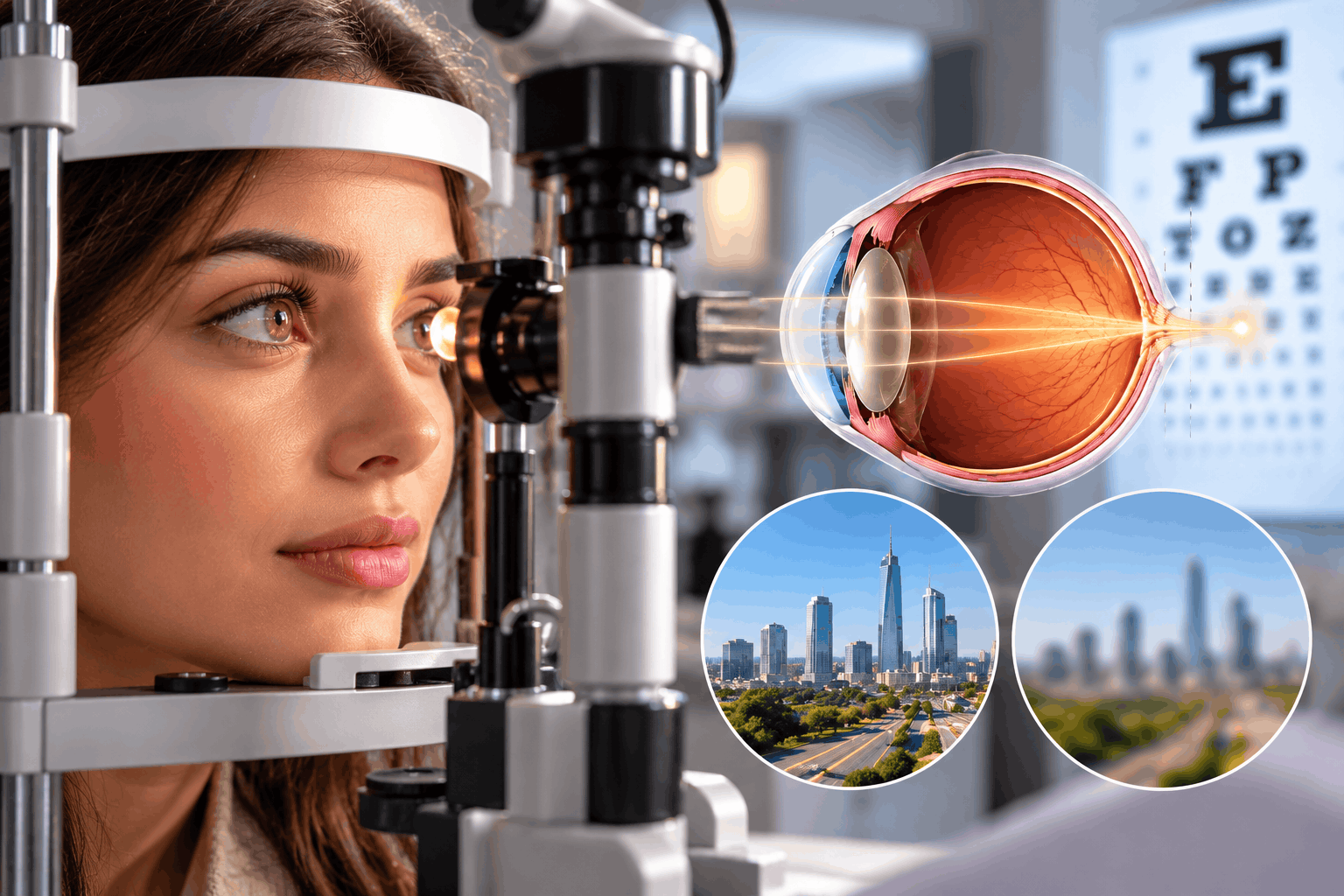
Refractive errors are common conditions that affect how the eye focuses light, making objects appear blurred or distorted.
For clear vision, the cornea and the crystalline lens work together to bend incoming light rays so they focus accurately on the retina, the light-sensitive layer at the back of the eye.
When the shape, length, or optical focusing power of the eye prevents light from focusing properly on the retina, a refractive error occurs.
Refractive errors can affect one eye or both eyes. They may be present from childhood, change during growth, or become more noticeable with age.
The Four Main Types of Refractive Errors
1. Myopia (Nearsightedness)
Myopia occurs when incoming light focuses in front of the retina, usually because the eye is relatively long or its optical power is too strong. Nearby objects may appear clear, while distant objects appear blurred.
2. Hyperopia (Farsightedness)
Hyperopia occurs when the eye has insufficient focusing power relative to its length. Without adequate accommodation, light would focus behind the retina. Near tasks may be difficult, although significant hyperopia can cause blurry vision at both near and far distances.
3. Astigmatism
Astigmatism occurs when the cornea or lens has different curvatures in different meridians, causing light to focus unevenly. It may produce blurred, stretched, or distorted vision at various distances.
4. Presbyopia
Presbyopia is the gradual age-related reduction in the eye's ability to focus on nearby objects. It usually becomes noticeable during the early to mid-40s as the natural lens becomes less flexible.
A person may have more than one refractive error at the same time. For example, myopia or hyperopia may occur together with astigmatism, and presbyopia can develop later in life.
Refractive errors are not necessarily diseases of the retina or optic nerve. However, significant uncorrected refractive errors can affect daily activities and, in children, may interfere with normal visual development.
Most people can achieve clearer and more comfortable vision with appropriate correction. A comprehensive eye examination determines the type and degree of refractive error and identifies any additional eye conditions that may affect vision.
Symptoms
The symptoms of refractive errors depend on the specific type, degree of optical error, age, and visual needs of the patient.
Common symptoms include:
• Blurred vision when looking at distant or nearby objects.
• Difficulty reading signs, classroom boards, or distant text.
• Difficulty reading books, smartphones, or small print.
• Squinting to improve visual clarity.
• Eyestrain or tired eyes after prolonged visual activities.
• Headaches, particularly after reading or computer work.
• Difficulty maintaining comfortable focus.
• Hazy or distorted vision.
• Glare or halos around lights, especially at night.
• Reduced visual comfort while driving.
• Needing to hold reading materials farther away.
• Occasional ghosting or overlapping images.
Symptoms by Type
Myopia
Distance vision is usually affected more than near vision. A child may sit close to a screen or have difficulty reading the classroom board.
Hyperopia
Near activities may require extra focusing effort, causing blurred vision, headaches, or eyestrain. Higher degrees may also blur distance vision.
Astigmatism
Vision may appear blurred, stretched, shadowed, or distorted at different distances. Nighttime glare may be particularly noticeable.
Presbyopia
Patients commonly hold reading materials farther away, require brighter light, or struggle to read small print at a normal working distance.
Symptoms in Children
Children may not realize that their vision is abnormal, especially if they have always seen the world in the same way.
Possible signs include squinting, holding objects unusually close, difficulty with schoolwork, eye turning, or avoiding visually demanding tasks.
Some patients have no obvious symptoms, making routine eye examinations important.
Sudden vision loss, flashes of light, a curtain-like shadow, or severe eye pain are not typical symptoms of uncomplicated refractive errors and require urgent medical evaluation.
Causes
Refractive errors develop when the eye's optical focusing power does not match its structural dimensions or its ability to adjust focus.
Different types of refractive errors have different underlying causes.
1. Differences in Eyeball Length
The distance from the front of the eye to the retina is known as axial length.
An eye that is relatively long may focus light in front of the retina, contributing to myopia.
An eye that is relatively short may have insufficient optical power for its length, contributing to hyperopia.
2. Corneal Curvature
The cornea provides a large proportion of the eye's focusing power.
Differences in corneal curvature can affect how strongly light is bent.
Astigmatism often occurs when the cornea has different curvatures along different directions.
3. Crystalline Lens Characteristics
The natural lens helps focus light and changes shape during accommodation.
Differences in lens power may contribute to refractive errors, while age-related loss of lens flexibility causes presbyopia.
4. Eye Growth and Development
Myopia commonly begins during childhood as the eye grows. The degree of myopia may increase during the school years and adolescence.
Some hyperopia is common in young children and may decrease as the eye develops.
5. Hereditary Factors
Genetic factors contribute to the development of several refractive errors.
Having family members with myopia, hyperopia, or astigmatism may increase the likelihood of similar conditions.
6. Environmental and Lifestyle Associations
Time spent outdoors and patterns of near work are associated with myopia development in children, although the relationship is complex.
Prolonged screen use may also cause digital eyestrain, which can occur with or without a refractive error.
7. Age-Related Changes
Presbyopia results from the normal aging process and the progressive loss of accommodation.
8. Changes After Eye Injury, Disease, or Surgery
Certain corneal disorders, injuries, and surgical procedures may alter refractive power.
Because several mechanisms can produce blurred vision, an ophthalmic examination is needed to distinguish refractive errors from other eye conditions.
Risk Factors
Anyone can develop a refractive error, and some types are extremely common throughout life.
Important factors include:
Family History
A family history of refractive errors, particularly myopia, can increase susceptibility.
Childhood and Adolescence
Myopia frequently begins during school age and may progress while the eye continues to grow.
Age Over 40
Presbyopia commonly becomes noticeable during the early to mid-40s and progresses as near-focusing ability declines.
Eye Anatomy
Variations in axial length, corneal curvature, and lens power influence refractive status.
Limited Outdoor Time in Children
Spending relatively little time outdoors is associated with a higher risk of developing childhood myopia.
Visual and Educational Demands
Intensive near work and educational environments are associated with myopia in population studies, although they are not the sole causes.
Existing Refractive Error
A patient may develop additional refractive changes over time or have multiple refractive errors simultaneously.
Certain Corneal Disorders
Conditions that change corneal shape, such as keratoconus, may produce irregular astigmatism.
Previous Eye Trauma or Surgery
Some injuries and procedures can change the eye's refractive characteristics.
Underlying Eye Conditions
Cataracts and other ocular disorders can sometimes alter the eye's prescription.
Children with high refractive errors or a substantial prescription difference between the eyes are at greater risk of amblyopia.
High myopia is also associated with an increased risk of certain retinal complications.
Risk factors do not establish a diagnosis. Individual assessment is required to determine the type of refractive error and whether correction is necessary.
Diagnosis
Refractive errors are diagnosed during a comprehensive eye examination.
The assessment helps determine the patient's prescription, evaluate how the eyes work together, and exclude other causes of blurred vision.
1. Medical and Visual History
The ophthalmologist asks about blurred vision, headaches, reading difficulties, occupational or school activities, and any previous glasses or contact lens prescriptions.
2. Distance Visual Acuity Testing
The patient reads letters or symbols on a chart to measure visual clarity at distance, with and without correction.
3. Near Visual Acuity Testing
Near vision is assessed using reading charts or similar tasks, especially when hyperopia or presbyopia is suspected.
4. Objective Refraction
Autorefraction and retinoscopy help estimate the eye's refractive error.
These methods are particularly useful during pediatric examinations or when a patient cannot reliably respond to subjective testing.
5. Subjective Refraction
Different corrective lenses are presented to determine the prescription that provides the clearest and most comfortable vision.
6. Cycloplegic Refraction
Special eye drops temporarily relax accommodation, allowing more accurate assessment of refractive error.
This is particularly important in children and patients with suspected hidden hyperopia or accommodative eye turning.
7. Eye Alignment and Binocular Vision Testing
Cover testing and other assessments may be performed to identify strabismus, focusing difficulties, or binocular vision disorders.
8. Slit-Lamp Examination
The cornea, lens, and anterior structures of the eye are examined for abnormalities that might affect visual clarity.
9. Dilated Fundus Examination
When indicated, the retina and optic nerve are examined to detect other conditions that may contribute to visual impairment.
10. Additional Investigations
Patients being evaluated for refractive surgery may need corneal topography, corneal tomography, pachymetry, tear-film assessment, and other specialized measurements.
Children with significant refractive errors may also require assessment for amblyopia.
Following evaluation, the ophthalmologist recommends a correction plan based on the patient's prescription, age, eye health, and visual requirements.
Treatment Options
The purpose of treatment is to focus light accurately on the retina, improve vision, reduce visual discomfort, and address associated conditions.
The most appropriate treatment depends on the type and degree of refractive error, age, lifestyle, eye health, and personal preferences.
1. Prescription Eyeglasses
Eyeglasses are a safe and effective option for correcting most refractive errors.
Different lens designs are used according to the patient's needs:
• Minus-powered lenses for myopia.
• Plus-powered lenses for hyperopia.
• Cylindrical correction for astigmatism.
• Reading or multifocal lenses for presbyopia.
Some patients need single-vision glasses, while others benefit from bifocal or progressive lenses.
2. Contact Lenses
Contact lenses correct refractive errors directly at the eye's surface.
Available designs include soft spherical lenses, toric lenses for astigmatism, rigid gas-permeable lenses, and multifocal lenses.
They require professional fitting and careful hygiene.
Unsafe contact lens use can increase the risk of serious corneal infection.
3. Laser Refractive Surgery
Selected adults with stable prescriptions may be candidates for corneal laser vision correction.
Procedures may include LASIK, PRK, or suitable lenticule-based techniques.
These procedures reshape or modify the cornea's refractive power to reduce dependence on glasses or contact lenses.
Not all prescriptions or corneal conditions are suitable for laser treatment.
4. Implantable Collamer or Phakic Intraocular Lenses
Selected patients, particularly some adults with higher refractive errors, may be considered for an intraocular lens implanted while the natural crystalline lens remains in place.
Eligibility depends on detailed ocular measurements and a discussion of surgical risks.
5. Refractive Lens Exchange
In selected patients, the natural lens may be replaced with an intraocular lens designed to provide refractive correction.
This option is generally considered according to age, lens status, prescription, and individual circumstances.
It is an intraocular procedure with potential complications and is not suitable for everyone.
6. Presbyopia Management
Reading glasses, progressive spectacles, multifocal contact lenses, and selected medical or surgical options may help patients who have difficulty focusing on nearby objects.
The appropriate method depends on their visual priorities and suitability.
7. Myopia Management in Children
For children with progressive myopia, an ophthalmologist may recommend evidence-based myopia control strategies.
Depending on the child's age, prescription, and local availability, options may include specially designed spectacle lenses, selected contact lenses, or low-dose atropine treatment.
Increasing safe outdoor time may also help reduce the risk of developing childhood myopia.
These approaches require professional supervision and do not guarantee that progression will stop completely.
8. Management of Hyperopia and Amblyopia
Children with significant hyperopia may need glasses to support normal visual development or manage accommodative esotropia.
If amblyopia is present, additional treatment such as patching or prescribed penalization may be required.
9. Monitoring and Prescription Updates
Refractive needs can change over time, especially during childhood and after the onset of presbyopia.
Regular eye examinations help ensure that the selected correction remains appropriate.
10. Treatment Limitations
Not everyone with a small refractive error requires immediate treatment, especially if vision is comfortable and functional.
Refractive surgery carries risks and does not guarantee complete freedom from glasses.
The treatment plan should always be individualized after a comprehensive examination and discussion with an ophthalmologist.
Prevention & Care
Not all refractive errors can be prevented because genetic factors, eye anatomy, and normal aging play important roles.
However, early detection, appropriate correction, and healthy visual habits can help reduce complications and improve quality of life.
Recommended measures include:
• Attend regular comprehensive eye examinations.
• Ensure children receive vision screening and appropriate follow-up.
• Wear prescribed glasses or contact lenses as recommended.
• Seek reassessment if vision becomes blurry despite current correction.
• Encourage children to spend time outdoors safely as part of their daily routines.
• Take regular breaks during prolonged near work or screen use to reduce visual discomfort.
• Maintain comfortable reading distances and suitable lighting.
• Follow safe contact lens hygiene practices.
• Avoid sleeping or swimming in contact lenses unless specifically advised under appropriate clinical guidance.
• Do not share contact lenses or use tap water to clean them.
• Monitor refractive changes in school-aged children.
• Follow recommended treatment for amblyopia or strabismus when present.
• Ask about myopia-control options if a child's prescription is progressing.
• Use protective eyewear when activities present a risk of injury.
• Discuss persistent headaches, eyestrain, or reduced visual clarity with an eye care professional.
For Children
Regular examinations are important because children may not recognize blurred vision.
High or unequal refractive errors can interfere with visual development and may require early treatment.
For Adults
Visual needs may change with age. Presbyopia commonly requires additional near-vision correction after the early 40s.
People considering refractive surgery should undergo a detailed assessment of the cornea, prescription stability, and general eye health.
Wearing correctly prescribed glasses does not weaken the eyes or make the refractive error progress faster.
Seek urgent care for sudden vision loss, new flashes with floaters, a dark curtain across vision, or severe eye pain. These symptoms require assessment for conditions other than uncomplicated refractive errors.
Frequently Asked Questions
What are refractive errors?
What are the four main types of refractive errors?
What is myopia?
What is hyperopia?
What is astigmatism?
What is presbyopia?
Can someone have more than one refractive error?
What causes refractive errors?
Are refractive errors hereditary?
What are the symptoms of refractive errors?
Can refractive errors affect children?
How are refractive errors diagnosed?
Do all refractive errors require glasses?
Can contact lenses correct refractive errors?
Can laser eye surgery correct refractive errors?
Is laser vision correction suitable for everyone?
Can refractive errors be prevented?
Does using digital screens cause all refractive errors?
Will wearing glasses make my eyesight weaker?
How often should I have an eye examination?
When should I seek urgent eye care?
Our team can help you with an individual medical assessment.