
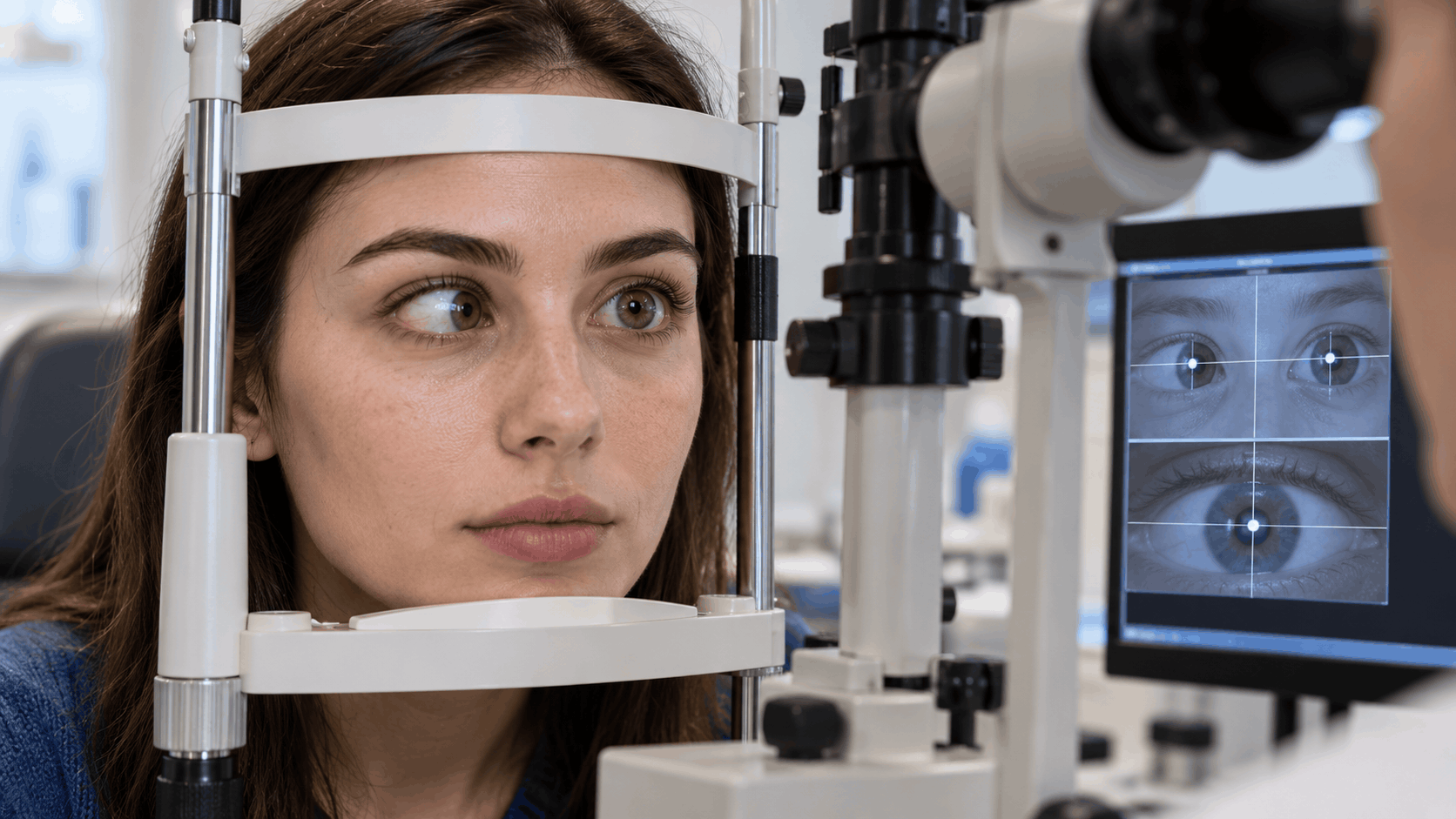
What Is It?
Strabismus is a condition in which the two eyes are not properly aligned and do not consistently look at the same object at the same time.
Under normal circumstances, the eyes work together to focus on a single target. Six extraocular muscles control the movement of each eye, while the brain coordinates their actions to maintain accurate alignment and binocular vision.
In strabismus, this coordination is disrupted, causing one eye to turn in a different direction from the other. The misalignment may affect one eye consistently or alternate between the two eyes.
Strabismus can be present from early childhood or develop later in life. It may be constant, meaning the eye is misaligned all the time, or intermittent, meaning the misalignment appears only under certain circumstances.
Main Types of Strabismus
1. Esotropia (Inward Eye Turning)
Esotropia occurs when one or both eyes turn inward toward the nose. It may develop during infancy or later in childhood. Some cases are associated with uncorrected farsightedness and improve with appropriate glasses.
2. Exotropia (Outward Eye Turning)
Exotropia occurs when an eye turns outward toward the ear. It may be intermittent, particularly when a person is tired, daydreaming, or looking into the distance.
3. Hypertropia (Upward Eye Turning)
Hypertropia occurs when one eye is positioned higher than the other. It may result from abnormalities affecting the eye muscles, their controlling nerves, or other structures.
4. Hypotropia (Downward Eye Turning)
Hypotropia describes an eye that turns downward relative to the other eye.
Strabismus may also be classified according to the age of onset, direction of deviation, frequency, and underlying mechanism.
In children, persistent eye misalignment may interfere with normal visual development. The brain may begin to suppress the image from one eye to avoid visual confusion, potentially leading to amblyopia, commonly called lazy eye.
In adults, newly developed strabismus frequently causes double vision because the brain receives two images that it cannot easily combine.
Strabismus is not merely a cosmetic condition. It can affect vision, depth perception, visual comfort, and everyday activities.
Early assessment is particularly important in children, as timely treatment can support normal visual development and reduce the risk of long-term visual impairment.
Treatment is individualized according to the patient's age, type of eye deviation, visual function, and underlying cause.
Symptoms
The symptoms of strabismus depend on the type and severity of eye misalignment, the age at which it develops, and whether the condition is constant or intermittent.
Common symptoms include:
• One eye turning inward, outward, upward, or downward.
• Eyes that do not appear to look in the same direction.
• Intermittent drifting of one eye, especially when tired or concentrating.
• Double vision (diplopia), particularly in adults with newly developed strabismus.
• Difficulty judging distances or reduced depth perception.
• Eye strain or visual fatigue.
• Difficulty focusing during reading or other close-up activities.
• Headaches associated with prolonged visual effort.
• Closing or covering one eye to see more comfortably.
• Squinting or closing one eye in bright sunlight, especially with intermittent exotropia.
• Tilting or turning the head to reduce double vision or improve alignment.
Symptoms in Children
Children may not complain about double vision because the developing brain can suppress the image from the misaligned eye.
Parents may notice that one eye turns inward or outward, that the child frequently tilts the head, or that the eyes appear to move differently.
Some children develop amblyopia, causing reduced vision in one eye even when appropriate glasses are worn.
Intermittent deviations may be difficult to detect because the child's eyes can appear normally aligned during part of the day.
Symptoms in Adults
Adults with new-onset strabismus may experience persistent or intermittent binocular double vision, visual confusion, eye fatigue, and difficulty with balance or depth perception.
An adult who has had strabismus since childhood may have little or no double vision because the brain has adapted over time.
Sudden-onset strabismus or double vision, especially when accompanied by a severe headache, weakness, drooping eyelid, unequal pupils, or other neurological symptoms, requires emergency medical evaluation.
Any persistent eye misalignment in a child should be assessed by an ophthalmologist rather than assumed to resolve naturally.
Causes
Strabismus develops when the normal coordination of the eyes is disrupted. This may involve the extraocular muscles, the nerves that control them, the brain's eye-movement systems, or the visual input received by each eye.
The cause is not always identifiable.
1. Abnormal Eye Movement Coordination
Many cases are related to differences in the neuromuscular control of eye alignment rather than a problem with the strength of the eye muscles themselves.
2. Refractive Errors
Significant uncorrected hyperopia (farsightedness) can cause excessive focusing effort. Because focusing and eye convergence are linked, some children develop inward eye turning known as accommodative esotropia.
3. Childhood-Onset Strabismus
Some children develop eye misalignment during infancy or early childhood without an obvious underlying disorder.
4. Family and Genetic Factors
Strabismus can occur more frequently within families, suggesting a genetic contribution in some patients.
5. Neurological Conditions
Certain conditions affecting the brain or cranial nerves may disrupt eye alignment.
Examples include:
• Cranial nerve palsies affecting eye movement.
• Cerebral palsy.
• Stroke.
• Other neurological disorders.
6. Thyroid Eye Disease
Thyroid-associated eye disease can affect tissues and muscles around the eyes, sometimes restricting eye movement and causing double vision.
7. Trauma
Head injuries, orbital fractures, or direct damage to the muscles and nerves controlling eye movement may result in strabismus.
8. Reduced Vision in One Eye
Conditions such as cataracts, retinal disorders, or optic nerve disease may reduce vision and interfere with binocular eye alignment. This can result in sensory strabismus.
9. Congenital Eye Movement Disorders
Certain developmental abnormalities, including Duane retraction syndrome and Brown syndrome, can affect eye movement and alignment.
10. Other Medical Conditions
Strabismus may be associated with conditions such as myasthenia gravis or other disorders affecting neuromuscular function.
11. Previous Eye Surgery
In some cases, changes in eye alignment can occur after certain ocular procedures.
In adults, new strabismus may have a different cause from childhood-onset strabismus and can occasionally be a sign of a serious underlying condition.
A comprehensive examination is essential to identify the type of misalignment and determine whether additional medical investigations are necessary.
Risk Factors
Several factors may increase the likelihood of developing strabismus, although the condition can occur without any known risk factors.
Family History
Children with a parent or sibling who has strabismus may have an increased likelihood of developing eye misalignment.
Significant Uncorrected Hyperopia
Farsightedness can contribute to accommodative esotropia in susceptible children.
Premature Birth
Children born prematurely have a higher risk of certain visual-development problems, including strabismus.
Developmental or Neurological Conditions
Conditions such as cerebral palsy and Down syndrome are associated with a greater likelihood of eye misalignment.
Reduced Vision in One Eye
Cataracts, retinal disease, optic nerve disorders, and other causes of reduced visual input may contribute to sensory strabismus.
Previous Strabismus
Individuals who were treated for strabismus during childhood may experience persistent or recurrent eye misalignment later in life.
Cranial Nerve Disorders
Conditions affecting the third, fourth, or sixth cranial nerves may disrupt normal eye movement.
Thyroid Eye Disease
Inflammation and structural changes involving the eye muscles may lead to restricted movement and misalignment.
Head or Orbital Trauma
Injuries involving the brain, eye muscles, orbital tissues, or controlling nerves can cause strabismus.
Certain Neuromuscular Conditions
Disorders such as myasthenia gravis may cause variable eye misalignment and double vision.
Increasing Age
Certain forms of adult-onset strabismus are associated with age-related changes in the tissues supporting eye alignment.
Having one or more risk factors does not mean strabismus will necessarily develop.
Regular pediatric vision screening and timely assessment of suspected eye misalignment can help detect problems before complications occur.
Diagnosis
Strabismus is diagnosed through a comprehensive ophthalmic examination that evaluates eye alignment, eye movements, visual acuity, refractive error, and binocular visual function.
In children, the examination may be performed by a pediatric ophthalmologist or an ophthalmologist experienced in childhood strabismus.
1. Medical and Visual History
The ophthalmologist asks about:
• The age when eye turning was first noticed.
• Whether the deviation is constant or intermittent.
• Whether one or both eyes are involved.
• Family history of strabismus or amblyopia.
• Previous glasses, patching, or eye surgery.
• Double vision, headaches, head tilting, or visual difficulties.
• Associated neurological or systemic symptoms.
2. Visual Acuity Assessment
Vision is assessed separately in each eye using age-appropriate tests.
In children, this is particularly important for identifying amblyopia associated with strabismus.
3. Cover and Uncover Testing
The cover test is one of the principal examinations used to detect eye misalignment.
By covering one eye and observing the movement of the other, the ophthalmologist can identify manifest or latent deviations.
4. Alternate Cover Testing
The alternate cover test helps assess the total angle of eye deviation.
Prisms may be used to measure the magnitude of misalignment.
5. Corneal Light Reflex Testing
Tests such as the Hirschberg test can help estimate eye alignment by observing the position of a reflected light on the cornea.
This may be especially useful in infants or young children.
6. Ocular Motility Examination
The ophthalmologist evaluates eye movements in different directions of gaze to identify restrictions, muscle imbalances, or possible cranial nerve abnormalities.
7. Cycloplegic Refraction
Dilating drops may be used to relax the focusing mechanism, allowing accurate measurement of refractive error.
This is particularly important when accommodative esotropia is suspected.
8. Binocular Vision and Stereopsis Testing
Specialized tests assess how effectively the eyes work together and whether the patient has normal or reduced depth perception.
9. Dilated Eye Examination
The ophthalmologist examines the retina, optic nerve, lens, and other ocular structures to identify conditions that may be contributing to misalignment or reduced vision.
10. Neurological or Additional Medical Investigations
When strabismus begins suddenly, particularly in adults, additional investigations may be needed.
Depending on symptoms and examination findings, these may include blood tests, neurological assessment, or imaging such as MRI or CT.
Not every patient requires imaging. The need for further investigation is based on the clinical presentation.
Accurate classification is essential because different types of strabismus require different treatment approaches.
Treatment Options
The treatment of strabismus aims to improve eye alignment, support binocular visual function, reduce double vision, and prevent or manage amblyopia in children.
Treatment depends on the patient's age, the type and magnitude of misalignment, underlying refractive errors, associated eye conditions, and overall visual needs.
1. Prescription Eyeglasses
Corrective glasses are an important treatment for certain forms of strabismus, particularly accommodative esotropia related to hyperopia.
By reducing excessive focusing effort, glasses may improve or fully correct the eye deviation in some children.
Some patients require glasses as part of a broader treatment plan.
2. Treatment of Amblyopia
Children with strabismus may develop amblyopia, which occurs when vision fails to develop normally in one or both eyes.
Amblyopia treatment may include:
• Prescription glasses.
• Patching of the stronger eye when recommended.
• Atropine penalization or other prescribed therapies.
• Selected newer binocular treatment approaches.
Patching and atropine are primarily used to improve vision in amblyopia. They do not directly correct every type of eye misalignment.
Early treatment is especially important because the visual system is more responsive during childhood.
3. Prism Glasses
Prism lenses redirect incoming light to reduce or relieve binocular double vision in selected patients.
They are especially useful for some adults with small or relatively stable eye deviations.
Prisms do not correct the underlying muscle or nerve disorder and are not suitable for every type of strabismus.
4. Selected Eye Exercises and Orthoptic Therapy
Specific exercises may benefit certain eye coordination disorders, such as convergence insufficiency.
However, exercises are not an established substitute for surgery or other appropriate treatment for all forms of strabismus.
The ophthalmologist determines whether orthoptic exercises are suitable for the individual patient.
5. Botulinum Toxin Injections
In selected cases, botulinum toxin may be injected into an extraocular muscle to temporarily weaken its action and help adjust eye alignment.
This approach is not appropriate for every patient and may be used in selected clinical situations.
6. Strabismus Surgery
Eye muscle surgery may be recommended when glasses or other nonsurgical measures do not provide adequate alignment, or when a particular type of deviation is best managed surgically.
During surgery, the ophthalmologist adjusts the position or action of one or more extraocular muscles.
Common techniques include:
Muscle Recession
The muscle attachment is moved backward to reduce its pulling effect.
Muscle Resection or Plication
A muscle is shortened or strengthened to alter eye position.
The specific procedure depends on the direction and magnitude of the eye deviation.
7. Adjustable Suture Surgery
In selected adult patients, adjustable sutures may allow fine-tuning of muscle position after surgery.
The suitability of this technique depends on the surgeon's assessment and the type of strabismus.
8. Treatment of Underlying Conditions
When strabismus is caused by neurological disease, thyroid eye disease, trauma, or another medical condition, management of that underlying cause is essential.
Some cases require coordination with neurologists, endocrinologists, or other specialists.
9. Recovery After Surgery
Following eye muscle surgery, patients may experience temporary redness, irritation, swelling, or discomfort.
Recovery instructions and follow-up schedules are provided by the surgical team.
Eye alignment and binocular function are assessed during follow-up, and some patients may continue to require glasses or other treatment.
10. Potential Surgical Risks
Strabismus surgery is generally effective in appropriately selected patients, but outcomes vary.
Possible risks include:
• Residual or recurrent misalignment.
• Overcorrection or undercorrection.
• Persistent or new double vision.
• Infection, bleeding, or scarring.
• Rare serious complications affecting the eye.
Some patients may require additional surgery or nonsurgical treatment.
11. Long-Term Follow-Up
Regular follow-up is important, particularly in growing children or individuals with recurrent strabismus.
Treatment may improve alignment and visual function, but the degree of binocular vision recovery depends on multiple factors, including age of onset and prior visual development.
Adults can also benefit from strabismus treatment; surgery is not restricted to children.
The best approach is determined through comprehensive examination and discussion of the patient's visual needs and expected outcomes.
Prevention & Care
Strabismus cannot always be prevented, particularly when it is associated with developmental, genetic, or neurological factors.
However, early detection and appropriate treatment can reduce the risk of complications, especially amblyopia in children.
Recommended measures include:
• Ensure children receive age-appropriate vision screening.
• Arrange an ophthalmic examination if one eye appears to turn inward, outward, upward, or downward.
• Do not assume persistent eye crossing in infants or young children will disappear naturally.
• Follow recommendations for prescribed glasses, including consistent use when indicated.
• Complete amblyopia treatment, such as patching or atropine, exactly as directed by the ophthalmologist.
• Attend scheduled follow-up visits to monitor eye alignment and visual development.
• Report changes in eye position, double vision, or visual behavior.
• Inform the ophthalmologist about relevant family history or neurological conditions.
• Seek assessment if a child frequently tilts the head, closes one eye, or has difficulty focusing.
• Maintain follow-up after strabismus surgery to identify residual or recurrent misalignment.
• Manage underlying conditions, such as thyroid eye disease or neurological disorders, with appropriate medical care.
• Avoid relying on unsupervised online eye exercises or treatments as substitutes for specialist evaluation.
For Parents
Persistent eye misalignment after early infancy should be evaluated. Even if the child's eyes appear straight some of the time, intermittent strabismus may still require assessment.
Apparent crossing caused by facial features, known as pseudostrabismus, can resemble true eye misalignment. An eye examination is needed to distinguish the two.
For Adults
Sudden-onset eye misalignment or new binocular double vision should receive prompt medical assessment.
If accompanied by severe headache, weakness, drooping eyelid, pupil changes, or other neurological symptoms, emergency care is necessary.
With accurate diagnosis, individualized treatment, and appropriate follow-up, many patients can achieve better eye alignment and improved visual function.
Frequently Asked Questions
What is strabismus?
What are the different types of strabismus?
Is strabismus the same as lazy eye?
Can babies have strabismus?
Will a child outgrow strabismus?
What causes crossed eyes in children?
Can adults develop strabismus?
Does strabismus cause double vision?
Can strabismus cause permanent vision problems?
How is strabismus diagnosed?
Can glasses correct strabismus?
Do eye exercises treat strabismus?
What are prism glasses used for?
Can eye patching straighten the eyes?
When is strabismus surgery recommended?
Can adults have successful strabismus surgery?
Will glasses still be needed after surgery?
Can strabismus return after treatment?
Is strabismus surgery only cosmetic?
What is pseudostrabismus?
When should strabismus be checked urgently?
Our team can help you with an individual medical assessment.